Friday, May 31, 2013

Original Site of Los Angeles City Jail

201 North Spring Street 

The first Los Angeles City Jail was erected in 1860 alongside the first City Hall, on the corner of Franklin Street and Spring Street. While neither structure exists in this location any longer, the jail served as the site of several lynchings. Of the 352 lynchings that took place in Los Angeles between 1850-1860, 126 were of Mexican or Hispanic men in the 19th century. The majority of these lynchings occurred due to conflicts during the post-Mexican-American war era between Hispanic “desperados” (known as outlaws in English) and the Los Angeles Sheriffs. The desperados were often accused of murdering Sheriffs and the ensuing drama led to the lynchings of large groups of Mexicans, reflecting the residual animosity between the incoming Anglos and the Mexicans already situated in the area. By lynching the Hispanic men they deemed as “criminals,” “white Americans sought to extend the genius of American republican institutions over…Latin cultural and political institutions.” 

In the particularly infamous cases of Juan Flores and Pancho Daniel, the pair killed Sheriff Barton and several of his colleagues—but managed to evade capture. Frustrated by their escape, law enforcement caught four other Mexican men and lynched them for “aiding” Flores and Daniel, but none of the men were ever found to have any connection with the murder. Although the criminals were imprisoned in the jail cells, the lynchings actually occurred from the beams of the City Hall porch. These men were executed in the cruelest fashion. According to accounts, “two of the condemned men fell before the job was done, because the ropes were poorly fastened, and had to be shot.” The tale of these men’s suffering is not uncommon; there are many more accounts of similar lynchings that took place in LA, which was widely known for its vigilante justice against Mexicans during this time. 


The underlying source of tension between Mexicans and Americans in California was a result of the Mexican-American War that ended in 1848 with the Treaty of Guadalupe Hidalgo, in which Mexico lost a majority of its land. Over the course of the next few years, the Mexicans in California became “a despised minority in their own homeland.” The Mexican-American War was part of a larger attempt for Americans to exercise their belief in Manifest Destiny and conquer the land—and its inhabitants. The lynchings that took place in the next few decades were yet another effort to continue the subordination of Mexicans. Naming Mexican criminals “desperados” demonized them. Franklin Street, known as “Jail Street,” was built over during the construction of the California State Building—now demolished. In present day, a parking lot and Grand Park occupy the space where the jail formerly stood. The new establishments have no direct correlation to the jail and there is no evidence of its existence in the landscape. However, this is emblematic of the tensions that existed and continue to exist between Latinos and Anglos. Although many Hispanic men unjustly suffered and died on that land, their stories remain untold and hidden in the landscape of a beautiful city park, whose tagline is ironically: “The Park for Everyone.”


For More Information
Blew, Robert. "Vigilantism in Los Angeles, 1835-1874." Southern California Quarterly 54.1 (1972): 11-30. 

Gonzales-Day, Ken. Lynching in the West: 1850-1935. Durham, NC: Duke University Press, 2006.

El Centro Chicano at the University of Southern California


United University Church 300
817 W. 34th Street

El Centro Chicano is the Latina/o student resource center at the University of Southern California dedicated to fostering “a community of critically thinking, socially conscious Chicana/o and Latina/o leaders: providing personal, social and academic support through graduation and beyond.” El Centro provides meeting space for student organizations, cultural programming, a freshman residential program, and a safe space for a diverse group of students.

El Centro Chicano opened its doors in 1972, under the initial directorship of Raul Vargas, who served as USC’s coordinator for Mexican-American Affairs. The push to establish El Centro Chicano at USC reflected the Chicano movement in the Vietnam War era in Southern California, when Chicano groups imagined new forms of community and empowerment of ethnic Mexicans. USC’s President John Hubbard agreed in an attempt to make the campus more inclusive of Mexican-American students. At the time, El Centro was described as “a meeting place for Mexican American students at USC,” but its foundation represented the growing political and ethnic consciousness of Chicano students at USC. Institutions like El Centro at predominately white institutions have served as “the sole safety line keeping many minorities from falling by the wayside.” Not only have the physical spaces proven important in this regard, but their adornment has as well: murals depicting the struggle of Chicanos and Latinos have characterized El Centro historically and today. 


Though El Centro Chicano has survived for four decades at USC, space has been a continual concern. El Centro was first housed in a two-story building at 3406 Hoover St., Los Angeles (see map). However, in 1979, El Centro was relocated to its current home on the third floor of the United University Church (UUC). “The students are not happy” with the new location, said director Abel Amaya in 1980, “but they accepted it because it was temporary.” For the last thirty-three years, El Centro has been housed in this “temporary” location. 


El Centro Chicano is slated for relocation in July, 2013 to an office in USC’s old student union building, which is fifty percent smaller than its current space. This decision was made by top administrators and passed down the chain of command without warning or genuine discussion with the student community that the center serves. USC’s administration claims that the unanticipated relocation will increase synergy among the cultural centers on campus, but by most accounts there is already successful coordination among the centers. This seems like the beginning of the end of everything fought for by the Chicano movement in the 1970’s: a safe space for Chicanos/Latinos on campus to meet, study, and exercise their ethnic consciousness. A group of students, parents, and alumni have put up a fight, forming a group called El Centro Ambassadors, and advocating for a democratic decision-making process and the preservation of El Centro Chicano’s current home on the 3rd floor of the UUC. As long as the space in which El Centro operates continues to be marginalized, the experience of minority students at USC will also be compromised.

For More Information
Chávez, Ernesto.“Mi Raza Primero!” (My People First): Nationalism, Identity, and Insurgency in the Chicano Movement in Los Angeles, 1966-1978. Berkeley, CA: University of California Press, 2002.

Hurd, Clayton A. “Cinco de Mayo, Normative Whiteness, and the Marginalization of Mexican-Descent Students.” Anthropology and Education Quarterly. v. 39 no. 3. September, 2008. 293-313.

Los Angeles Youth Network: Hollywood Shelter


1550 N. Gower Street (Between Sunset & Hollywood)
Los Angeles, CA 90068

Hollywood Boulevard in Los Angeles is famously known around the world for its Walk of Fame, Academy Awards, and television studios and unless you are involved in the homeless youth subculture of Hollywood it is easy to miss the several teen homeless shelters located near major Hollywood landmarks. Youth become homeless because of family problems, economic problems, and residential instability. Many youth leave because of drug addiction in the family and abuse. LA County currently has the largest foster care system in the nation with 35,236 children. About 7,500 of those youth are currently between the ages of 13 and 17. Fifty-nine percent of minors who are in foster care/homeless are Latino and 26.2% are African-American. It is evenly split among gender, 50% male and 50% female. The Los Angeles Youth Network is a non-profit organization that serves the homeless teen population in the Hollywood area in efforts to protect and house youth.

The Los Angeles Youth Network (LAYN) began as a pilot program through Children’s Hospital Los Angeles High Risk Youth Project after the California Homeless Youth Act (CHYA) passed in 1985. The CHYA recognized that over 200,000 youth experienced homelessness in California and that the state had no clear policy to reduce youth homelessness. This Act declared homeless youth a special needs population and proposed continued shelter and services for these youth. Due to the decreased availability of affordable housing because of urban development and decreased public benefits homelessness became a grave national issue beginning in the 1970’s, according to research figures published by the National Coalition for the Homeless in 2005. Homeless and runaway youth often choose to come to Hollywood because of its unique subculture, reputation, warm weather, and availability of outreach services. Because services are located relatively close, youth are able to conveniently access them. Only blocks away from this facility are other teen shelters. Many people in the community are unaware that such facilities are in their neighborhood and are unaware of its services.


The LAYN Hollywood Youth Shelter had a mural on the front of the facility that was painted in 1994 and was then painted over in 2009 during renovation. The mural showed Dorothy from the Wizard of Oz sleeping on a yellow brick road. She had suitcases with her and there were rats around her and her food basket. The mural also showed a silhouette of the Wicked Witch of the West with smaller depictions of knives, needles, guns, bullets and pills. Lastly, there are stars on the yellow brick road (like those on the Walk of Fame) with inspiring words such as hope and courage. The Dorothy mural symbolized Dorothy trying to find her way home. These teen homeless shelters portray a different story of Hollywood and Los Angeles that depicts the disparity between economic classes, poverty, and class struggle. While Hollywood is a tourist attraction to folks around the world, it is also a safe haven for young people in search for stability and safety.


For More Information
Dunitz, Robin J. Street Gallery: A Guide to 1000 Los Angeles Murals. Los Angeles, CA: RJD Enterprises, 1993.

Komen, Matt. "Los Angeles Youth Network." May 4, 2013. www.layn.org

Vermont-Slauson Shopping Center

5852 South Vermont Avenue
Los Angeles, CA 90044 

Vermont-Slauson Shopping Center was once a key economic artery for South Los Angeles. It thrived with business, as it was home to high retail shops that served many middle class whites. And yet, it is a neighborhood that has long suffered from social problems, including a declining number of jobs and an increase in crime and poverty rates. 

The Vermont-Slauson Neighborhood opened its doors to a Sears in 1927. This retail store attracted many people since it was the only shopping center in the Southwest Los Angeles area, as it was called in the first half of the twentieth century. In mid 1940’s, a racial shift began when California’s population exploded with post-World War II migration, including many African-Americans fleeing the harsh discrimination of the U.S. South. With the wave of African-Americans came housing discrimination. Racism led to an increase in racial tensions. Slowly, middle-class African-Americans began populating the neighborhoods of Southwest Los Angeles. By the 1960’s, Vermont-Slauson was a predominantly African-American neighborhood. 

Circa 1980

With the increase of African Americans came a decrease in white residents, as many fled to the suburbs. White flight led to this once prosperous area to experience a decline in sales, a decrease in property values, and the racial shift in schools. In 1965, the Watt’s riots hit South Central Los Angeles and scared off the last remaining white residents of the area. Bankers and insurers dealt the area another crushing blow by redlining the area and investing elsewhere. There was no surprise when Sears, the neighborhood’s biggest two story retail shop, closed after eight years of declining sales in 1976. With the absence of Sears, all the surrounding mom and pop shops, who were rebounding from the 1965 Watts Riots, suffered a decline in sales. “It is not profitable to stay,” Sears told Rep. Yvonne Burke’s office.

The community tried to get back on its feet, holding several meetings in hopes of coming up with a plan to revamp the neighborhood. After several attempts to try and get big retail stores to invest, according to The Daily Trojan USC considered taking over the lot in hopes of revitalizing the residential area. However, the mayor and the local officials decided to give the money and support to the neighborhood and to non-profits. With much effort, a new shopping center began construction in 1981. It would behave like a money machine, generating profits, which had to be put back into developing the neighborhood.

Parking lot of remodeled Vermont-Slauson Shopping Center circa 2013.

The current population is predominantly Latino. There is no evidence of the old shopping center; all that is left is a flee-market, crime, many people, and homelessness in the neighborhood. Vermont-Slauson illustrates the reluctance of private enterprise to invest in the Black ghetto, the inherent economic limitations of segregated and poor parts of the city, and the difficulty that bureaucracy has in bringing help to the neighborhood. To this day, many of the residents do not see how the new shopping center has brought economic or social power to the struggling neighborhood. 

For More Information
Boyarsky, Bill. "Neighborhood Renewal a Complex Puzzle: Slauson-Vermont Typifies Program's Problems." Los Angeles Times 27 November 1978: C1. Print.

Schoch, Deborah. "Teens Walk the Talk into History; Students Lead Tours of South Vermont Avenue, Telling of its Past as Part of Studying its Economy." Los Angeles Times Jun 10 2007: 0. ProQuest. PROQUESTMS. 12 May 2013 <http://ezproxy.lapl.org/login?url=http://search.proquest.com/docview/422141618?accountid=6749>

"Store Will Open Saturday: Ceremonies Being Arranged for Formal Debut of Sears, Roebuck Vermont-Slauson House." Los Angeles Times 23 June 1927: 22. Print


Thursday, May 30, 2013

USC University Village


3375 S Hoover St
Los Angeles, CA 90007

Directly adjacent to USC’s University Park Campus lies a community shopping center known as the University Village. It was built in 1974 as part of the Hoover Redevelopment Project in an effort to “improve the area surrounding USC and beautify the South-central Los Angeles area.” The 14.6 acre retail and office complex, consisting of a grocery store, movie theater, small shops, and an array of dining options, is bordered by Jefferson Blvd, McClintock Ave, 30th Street, and Hoover Street. Initially, the shopping center was designed to cater to the needs of both the community and the university and was praised for its diversity. However, USC’s $25-million acquisition of the shopping center in 1999 challenged the original intentions behind the project.


Currently, USC administrators and students consider the University Village to be a place that it “is dated, has limited retail offerings, and needs to be replaced.” USC’s Master Plan to revitalize the area involves tearing down the University Village, along with two USC-owned apartment complexes, in order to build a new shopping center, “The Village at USC.” This new center is said to include “350,000 square feet of community-serving retail, new student housing and academic space, and will increase the quality of life for students and the community.” This plan, however, reflects a significant emphasis on university interests while ignoring essential community needs. Once the only space that integrated the community and the university, the new Village with its upscale retail, restaurants and student housing, will do very little for the community. USC’s overt attempt to gentrify the area, and thus push out the surrounding low-income community, counters the university’s claim that it is most concerned with helping the community.

The Figueroa Corridor Coalition for Economic Justice (FCCEJ), a community advocacy group, along with many local residents and business owners, have expressed concern over the potentially harmful affects this new development would have on the community. Some of these issues already plaguing the community, including the ongoing elimination of affordable housing, dramatically increased traffic, air pollution, and decreased pedestrian and public safety, are consequences of the university’s expansion and growing demand for student housing over the years. As an organization that aims to alleviate some of the negative effects on community stability and affordable housing that have arisen in the area immediately surrounding USC, the FCCEJ has responded by expressing its concern that this new development might worsen the situation. USC is set on moving forward with its master plan. However, the FCCEJ has collaborated with the university to ensure that this new development includes and benefits all members of the community.

While it cannot offset the gentrifying effects this plan will have on the community, USC must recognize its moral responsibility to adhere to the needs of the community. In 2012, the $1-billion Village at USC plan was approved by Los Angeles City Council, but not without the promise of substantial community benefits. The provisions outlined in the community benefits agreement include a $20 million contribution from the university that will go towards maintaining affordable housing in the surrounding area, a promise to hire 30% of the workforce for the project from within a five mile radius from campus, and the creation of a legal clinic at its Gould School of Law to help local residents with tenant-landlord disputes.

For More Information
“$1-billion Village at USC approved by L.A. council panel.” (2012, Oct 12). Los Angeles Times.

Loeterman, Dan. "Residents Oppose Master Plan - SAJE :: Shift Power, Change Lives." Residents Oppose Master Plan - SAJE :: Shift Power, Change Lives. Web. 14 May 2013. <http://www.saje.net/site/c.hkLQJcMUKrH/b.3998783/>.

“University Park Campus Master Plan History.” University Park Campus Master Planning. Web. May 2013. <http://www.usc.edu/community/upcmasterplan/background/history/1961/>.

Lot

1800 W 54th Street
Los Angeles, CA 90062

A lot sits on the corner of
Western Avenue and 54th Street, in the heart of South Los Angeles. From what is visible
to the public, this lot is filled
with many trailers, different
kinds of wild flora, and the
uncertainty of the well being of
neighboring residents. Local residents have expressed
concern about the questionable
activity that takes place in the
lot. There is an elementary school across the street and many parents do not feel comfortable letting their children walk by the lot, unsure of the kind of people who are in it or things that are being done. When a local resident, Antonia Garcia, was asked how she feels about the lot she responded, “I think that it’s dangerous and that it gives this area a bad name because it looks so suspicious and dark.” No one is really sure of what occurs in the lot, especially because its perimeter is covered with black plastic blankets, which gives off a bad connotation. It is clear that the lot is closed off to outsiders because when I tried to obtain an interview from someone inside, I felt an instant, hostile, and unwelcome energy. The best thing to do was to get out before something bad or unwanted happened.

The dark, unfriendly lot was once a McDonald’s restaurant where
children played freely and
cheerfully. In 1998, McDonald’s corporation decided to
move the location of the restaurant
to a new shopping center five
blocks south of Western Avenue. Despite the requests of the
residents to keep it in the same
location, McDonald’s decided to
move it to the shopping center
because of the possibility of a larger profit. After the demolition of the McDonald’s, a sign was put up displaying the future plans for the lot. As time passed, nothing was built and the abandoned lot remained empty. Little by little trailers began to inhabit the lot and coverings were put up to block the view from the outside in. Fear and concern began to grow in the residents, as the lot became a secretive and mysterious place. Ironically, located across the street from the lot is a famous Civil Rights mural, “Freedom Won’t Wait,” that symbolizes community empowerment and the fight against oppression. This mural represents the strength and unity of the community, which has been overpowered by the uprising of the lot.

Fifteen years have passed and the lot remains the same. This is a prime example of how major corporations, like McDonald’s, are able to triumph over communities because they prefer fiscal gain to the well-being and safety of the people. The residents live with uncertainty because they do not know what is taking place or what can occur because of the lot. The struggle of power over land and security still remains in South Los Angeles and can be seen by this lot within the community.

For More Information
Caldwell, Melissa L. "The McDonaldization of Society." Food, Culture & Society 13.2. Academic OneFile. 2010. Web.
Pulido, Laura, Barraclough, Laura, Cheng, Wendy. A People’s Guide to Los Angeles. University of California Press. 2012. Print.
Robertson, Grant. “Hungry Times, and McDonald's is Lovin' It.” Lexis Nexis. 2009. Web.

Judith F. Baca’s “Danzas Indigenas” Monument


Baldwin Park

4085 Downing Ave. Baldwin Park, CA 91706
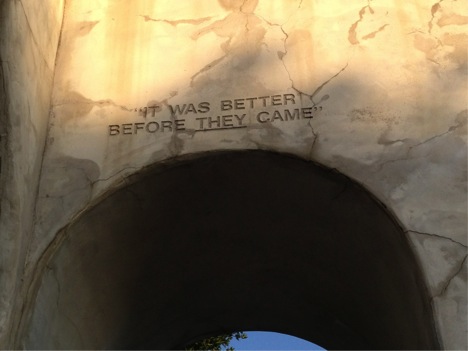
In 1993, Judith F. Baca was hired by L.A. County to erect a monument in the city of Baldwin Park, California. The monument itself is very large; consisting of a 20 foot arch and a 100 foot plaza. Ms. Baca allowed local residents to influence her creation by including quotes to represent the Latino community and tell the invisible history of the city and its people. 

The monument became controversial because of one quotation: “it was better before they came.” The monument was erected and stood without controversy for a dozen years. In 2005, Save Our State (SOS), an anti-immigrant organization, discovered the monument and organized to have it removed because of its supposedly anti-American ideology. After the 2001 terrorist attacks, it became common for anti-immigrant groups to label minority groups’ art, culture, and history as anti-American. Not surprisingly, SOS falsely claimed the quote was part of the Reconquista Movement, a movement which supposedly intended to give back Mexico the lands that once belonged to it, including California. To this day, there is no proof this radical organization ever existed.

Dr. Laura Pulido has argued that anti-immigrant organizations, such as SOS, have used Latino organizations as scapegoats. In other words, SOS will use manipulation to portray Latino groups as supporters of anti-American ideologies. In this case, the goal of SOS was to portray Baldwin Park as a haven of the non-existent anti-American Reconquista ideology to remove the monument. The executive director of SOS, Joseph Turner, argued that the monument was “seditious in nature, it essentially talks about returning this land to Mexico” and organized a protest for its removal.

The controversial quote forced Ms. Baca to reveal the fact that the quote was said by a local Anglo resident who was originally from Arkansas and disapproved of the number of Mexican people inhabiting the city. Ms. Baca selected the quote because it represents the mentality of the past and present, which Latinos continue to endure and overcome, and because of its ambiguity. In her words, “it was designed to say more about the reader than the speaker.” SOS clearly and maliciously interpreted the quote for the purpose of “destroying a spiritual site of public memory….to see [Latino] history silenced and erased…. [and] to incite violence through hate and fear”. Preston Wood, a defender of the monument described the animosity of the protest and claimed a locally organized demonstration was “a real grass-roots mobilization of [Latinos] who are outraged over racist ideology in Los Angeles".

In a larger context, the tension between Latinos and SOS was expected. After September 2001, most immigration legislation has sought to make it more difficult for immigrants to live a normal working life in the US. For instance, H.R. 4437 was passed by the US House of Representatives in 2005 and although it did not pass the Senate it generated rancor between groups such as SOS and Latinos. Not only was the bill intended to increase the militarization of the US and Mexico border, but also required all police to deport immigrants for any legal infraction and forced employers to verify their employees’ legal status.

The day of the protest, approximately 50 SOS members were present and encountered 500 counter protesters made up of Latino residents defending their rights to the monument, their history, and to demonstrate they would not be intimidated. City Mayor Manuel Lozano exclaimed that the monument would stand for over “40 years so your grandchildren will enjoy it!” As a Latino, he understood the frustration of many of his constituents and stood with them against SOS and the anti-immigrant legislation seen across the US. This event only amplified the meaning behind the monument because it demonstrates the power struggle between Latinos and anti-immigrant groups. However, the monument will forever remind people of a time in which the Latino community flexed its will to maintain their identity in the face of adversity and persecution.

This declaration foreshadowed the massive demonstration which would take place on May 1st, 2006 where an estimated 1 million Latinos and their supporters marched in the streets of Los Angeles for amnesty and worker’s rights for Mexican-immigrants.

For More Information
Pierson, D., & Biederman, P. W. (2005, May 15). Protest Over Art Forces Police to Draw the Line - Los Angeles Times. Featured Articles From The Los Angeles Times. Retrieved May 4, 2013, from http://articles.latimes.com/2005/may/15/local/me-mural15

Pulido, L. (2007), A Day Without Immigrants: The Racial and Class Politics of Immigrant Exclusion. Antipode, 39: 1–7. doi: 10.1111/j.1467-8330.2007.00502.x